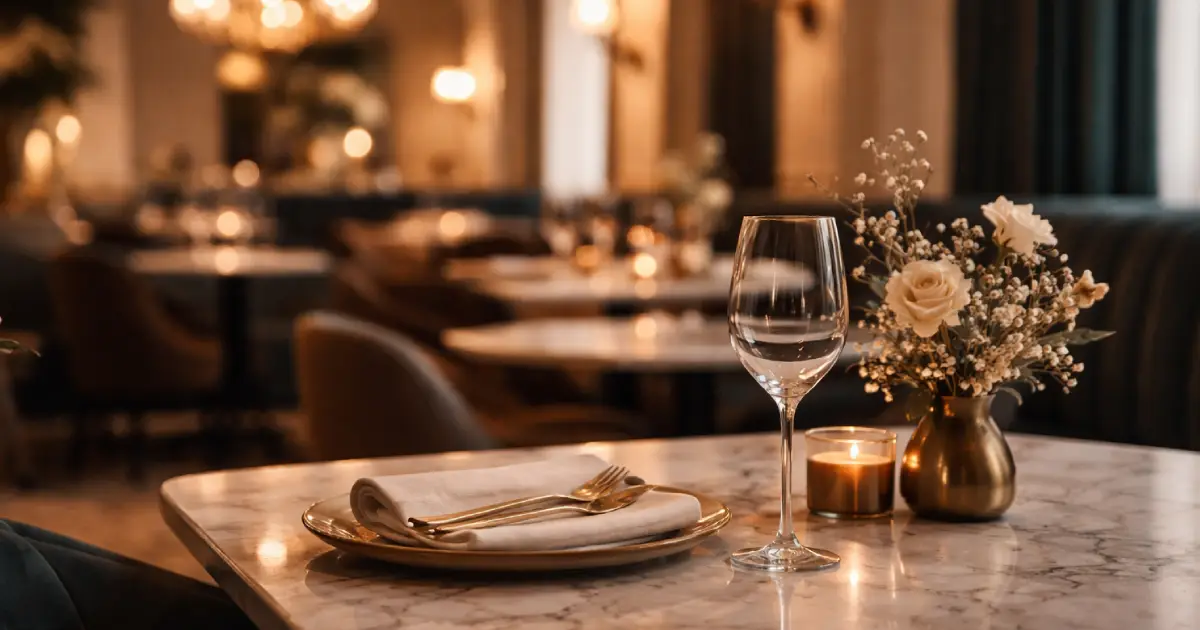
Vienna's dining scene is dense, competitive, and full of concepts fighting for attention. But the restaurants that succeed long-term share one thing in common: they're not just culinary standouts — they're clearly positioned as brands.
The key question: What separates a "good restaurant" from one that guests actively recommend, share on social media, and keep coming back to? The answer is almost never just the food — it's the brand.
Great food is no longer enough
Quality on the plate is the baseline. But it alone isn't enough to stand out in a saturated market. Guests today don't choose based on taste alone — they choose based on feeling.
What does the Instagram feed look like? How does the space feel? What story does the website tell? What's the concept behind the concept? All of that is brand strategy. And this is exactly where many restaurants fall short — not in the kitchen, but in perception.
What is brand strategy in hospitality?
Brand strategy means consciously defining what a restaurant stands for — and communicating that identity consistently across every touchpoint:
- ✓Positioning: What makes you unique? Why should someone choose you over the place next door?
- ✓Visual identity: Logo, color palette, typography, photo style — a cohesive image that's instantly recognizable.
- ✓Tone of voice: How do you speak? On the website, on social media, on the menu. Your brand's voice.
- ✓Experience: How does a visit feel? From the first Google result to the moment a guest walks out the door.
The most common mistakes
In our work with restaurants and hospitality concepts, we see the same patterns again and again:
The difference in practice
- No clear recognition value
- Inconsistent visual language
- Content produced reactively
- Guests come once — don't return
- Every marketing effort starts from zero
- Instant recognizability
- Every touchpoint tells the same story
- Content follows a clear direction
- Guests become regulars and advocates
- Every investment builds on the foundation
What strong restaurant brands do differently
The most successful hospitality concepts — whether in Vienna, Berlin, or internationally — understand that the brand isn't an add-on. It's the foundation.
A strong brand turns a good restaurant into a desirable experience.
- ✓They know exactly who their target audience is — and speak to them directly.
- ✓Every visual touchpoint tells the same story.
- ✓The on-site experience reflects what the brand promises online.
- ✓Content is produced strategically, not reactively.
The right time
Most restaurants only think about branding when problems arise — when occupancy drops, competition gets stronger, or a relaunch is needed. But the best time is before that.
Whether it's a new opening, a repositioning, or simply the desire to unlock full potential: a clear brand strategy always pays off. It saves money long-term because every decision is built on a solid foundation.
Frequently asked questions
What does brand strategy cost for a restaurant?
The investment depends on the scope — from strategic analysis to full visual implementation. We work both on a project basis and in long-term partnerships, and define the budget individually in conversation.
How long does the process take?
A thorough brand strategy typically takes 4–8 weeks for analysis, concept, and initial implementation. Visual rollout can happen in parallel or afterward.
Does a small restaurant also need brand strategy?
Especially smaller concepts benefit enormously. Those with less marketing budget need to be even more clearly positioned so every investment counts. Brand strategy isn't about size — it's about ambition.
What's the first step?
A no-obligation conversation where we understand your concept, identify potential, and sketch a possible roadmap. No commitment — just clarity.
Let's talk about your concept — no strings attached.
Schedule a conversation →Conclusion
Brand strategy isn't a luxury for large chains. It's what takes a restaurant from "well visited" to "clearly positioned, aesthetically present, and built for long-term relevance." In a market like Vienna, where the density of hospitality concepts is enormous, it's not optional — it's decisive.
If you're looking to strategically develop your restaurant or hospitality concept, we'd love to talk.